Box Dimensions: How to Measure, Write and Read L × W × H
Measure the product, add clearance to get the interior, then add the wall thickness to get the exterior. Factories build to the interior; couriers bill on the exterior. Write sizes as L × W × H in mm, length and width being the opening.
Updated 2026-11-15 · Dimensional weight calculator
Key takeaways
- Order: box dimensions are written length × width × height (L × W × H).
- The opening decides L and W: length is the longer side of the opening, width the shorter, height the depth at right angles to it. Height can be the longest number.
- Say inside or outside: packaging factories build to the interior; couriers and warehouses measure the exterior.
- Write the unit once and keep it: 200 × 150 × 50 mm (interior). 1 in = 25.4 mm.
What order do box dimensions go in?
Length × width × height. Look at the face that opens: its longer side is the length, its shorter side the width, and the distance from the opening to the bottom is the height (also called depth). A lid-and-base gift box opens on top, so a 200 × 150 × 50 mm box is a flat box 50 mm deep. A tuck-end carton also opens on top, so a 100 × 60 × 160 mm perfume or cosmetic carton is a tall box: height is the biggest number.
Same order, different shapes. Swap W and H on the carton and the factory makes a box lying on its side.
How to write and read box dimensions
- Keep the order L × W × H every time, opening first. “200 × 150 × 50” and “200 × 50 × 150” are different boxes.
- State the unit once, at the end: 200 × 150 × 50 mm, or 8 × 6 × 2 in. “×” and “x” both read as “by”.
- Label it interior or exterior (you will also see ID / OD, inside / outside).
- Use millimetres for drawings. Converting from inches, multiply by 25.4 and round to the whole millimetre; do not round an interior down, or the product will not fit.
One box, written three ways
| Where you see it | How it is written | What it measures |
|---|---|---|
| Factory quote or dieline | 200 × 150 × 50 mm (interior) | The cavity the product sits in |
| Your product listing or spec sheet | about 204 × 154 × 54 mm / 8.0 × 6.1 × 2.1 in (exterior) | The outside of the finished box: interior + two 2 mm greyboard walls per axis |
| Courier billing (UPS / FedEx) | 9 × 7 × 3 in | The exterior with each side rounded up to the whole inch, then used for dimensional weight |
Three sizes, one box
| Size | What it is | Who uses it |
|---|---|---|
| Product size | The packed product at its widest length, width and height (with tissue, pouch or insert if it ships in one) | You, to start |
| Interior (cavity) | Product + agreed clearance on both sides of each axis | The factory: dielines, inserts and quotes are built from this |
| Exterior | Interior + wall thickness on both sides (plus lid overhang on two-piece boxes) | Couriers, warehouses, shelf and display planning, dimensional weight |
Step by step
- Measure the product as it will ship. Use a caliper or rigid ruler at the widest points; for soft goods, fold them the way they will be packed.
- Name the opening. Length and width are the opening (length the longer side); height is the depth. A lid-and-base box opens on its top face, a drawer box on its end.
- Add clearance to both sides. Interior = product + clearance × 2 on each axis. Agree the clearance for your product, insert and removal method; the size guide has the rules.
- Add the walls for the exterior. Exterior ≈ interior + 2 × board thickness per axis, then add the lid overhang if the lid sits over the base.
- Confirm on a sample. Board grades vary; record the measured interior and exterior of the approved sample and use those numbers for re-orders and shipping.
Measuring a box you already have
To copy an existing box, measure the inside from wall to wall at the bottom of the cavity (not across the rim, which can flare), and the depth from the floor to the top edge of the base. Then measure the outside across the widest points with the lid on. Write both down, labelled. On a two-piece box, also measure the lid on its own: its inside must clear the outside of the base.
Odd-shaped products
For bottles, jars, sets and anything not square, measure the smallest rectangular block the product fits into: widest point on each axis, including caps, pumps, handles and ribbons. If the product sits in an insert, measure the insert instead, or send the product and let the factory size the insert and box around it.
Interior and exterior from your product size
| Size | mm | inches |
|---|
Exterior is an estimate for quoting and freight planning: interior + two wall thicknesses per axis. A lid that overhangs the base adds to length and width; ask for the lid size on your drawing.
Wall thickness to add
| Material | Thickness | Typical use | Interior → exterior, per axis |
|---|---|---|---|
| 1200 gsm greyboard | ~2 mm | boxes up to about 150 mm | +4 mm |
| 1500 gsm greyboard | ~2.5 mm | about 150–250 mm | +5 mm |
| 1800 gsm greyboard | ~3 mm | over 250 mm or contents over about 1 kg | +6 mm |
| E-flute corrugated (mailer) | ~1.5 mm | mailer boxes | +3 mm |
| B-flute corrugated | ~3 mm | heavier mailers and shippers | +6 mm |
Greyboard grades from the gift box size guide (GSM is mass per area; thickness depends on density and grade). Wrapping paper adds a fraction of a millimetre. Category sizes are in the table further down.
Five common box measuring mistakes
- Swapping width and height. On cartons and drawer boxes the depth is often the longest side; write the opening first.
- Mixing inside and outside. Quoting an exterior as if it were an interior makes the cavity two walls too small on every axis.
- Sizing the bare product. Inserts, velvet pads, tissue and pouches all take space; size from what actually goes in.
- Measuring with a soft tape. A tape sags and bends round corners. Use a caliper or a rigid ruler, at the widest points.
- Rounding inches down. 3.94 in written as 3.9 in loses 1 mm; on a fitted insert that is the difference between snug and stuck.
How box dimensions affect shipping cost
Couriers bill the greater of actual weight and dimensional weight, worked out from the exterior:
| Carrier basis | Formula |
|---|---|
| UPS, FedEx, USPS | L × W × H in inches ÷ 139 = lb (sides and result rounded up; USPS only on parcels over 1 cubic foot) |
| DHL Express | L × W × H in cm ÷ 5,000 = kg |
| Air freight (common ratio) | cm³ ÷ 6,000 = kg; your forwarder confirms its own ratio |
Example: the 9 × 7 × 3 in box above is 189 in³ ÷ 139 = 1.36, billed as 2 lb even if it weighs less. Trimming clearance by a few millimetres can drop a whole inch on one side. Rigid set-up boxes usually ship assembled, so the carton is full of air; mailers and foldable magnetic boxes ship flat. Rates and divisors as checked on 2026-10-31; try your own sizes in the dimensional weight calculator.
Common gift box sizes by product
Starting interior sizes from our category guides. Treat them as a first draft, then size from your own product and insert.
| Box | Interior (mm) | Interior (in) | Full guide |
|---|---|---|---|
| Ring box | 50 × 50 × 40 | 2.0 × 2.0 × 1.6 | Jewelry box sizes |
| Necklace box | 180 × 180 × 40 | 7.1 × 7.1 × 1.6 | Jewelry box sizes |
| Jar candle box (8–10 oz) | 100 × 100 × 120 | 3.9 × 3.9 × 4.7 | Candle box sizes |
| Perfume box (100 ml) | 110 × 90 × 160 | 4.3 × 3.5 × 6.3 | Cosmetic box sizes |
| Single wine bottle box | 350 × 95 × 95 | 13.8 × 3.7 × 3.7 | Wine box sizes |
| Compact PR kit | 250 × 180 × 90 | 9.8 × 7.1 × 3.5 | PR box sizes |
| Medium subscription mailer | 200 × 150 × 80 | 7.9 × 5.9 × 3.1 | Subscription box sizes |
More formats and clearance rules: gift box size guide · gift box types.
Send your supplier this
- Product size, or the interior you want, stated as interior or exterior
- Box style and which face opens (see gift box types)
- Insert material and the clearance you expect around the product
- Quantity, and whether boxes ship assembled or flat
Pick a Format, Then Size It
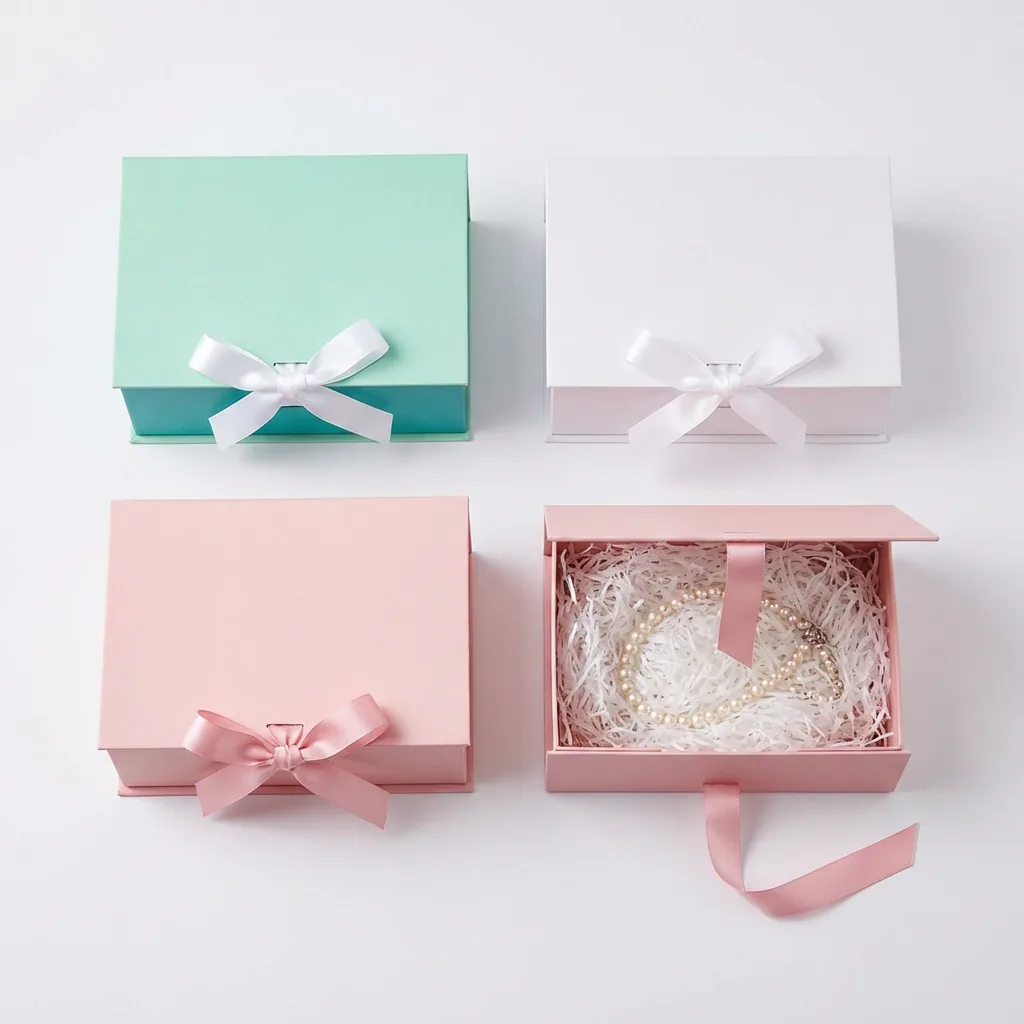
Magnetic Closure Rigid Box
Wrapped rigid board with a concealed magnetic flap.
From 100 pcs · best price 500+View product →
Lid & Base Gift Box with Ribbon
Two-piece rigid box; the lid lifts off for a slow reveal.
From 100 pcs · best price 500+View product →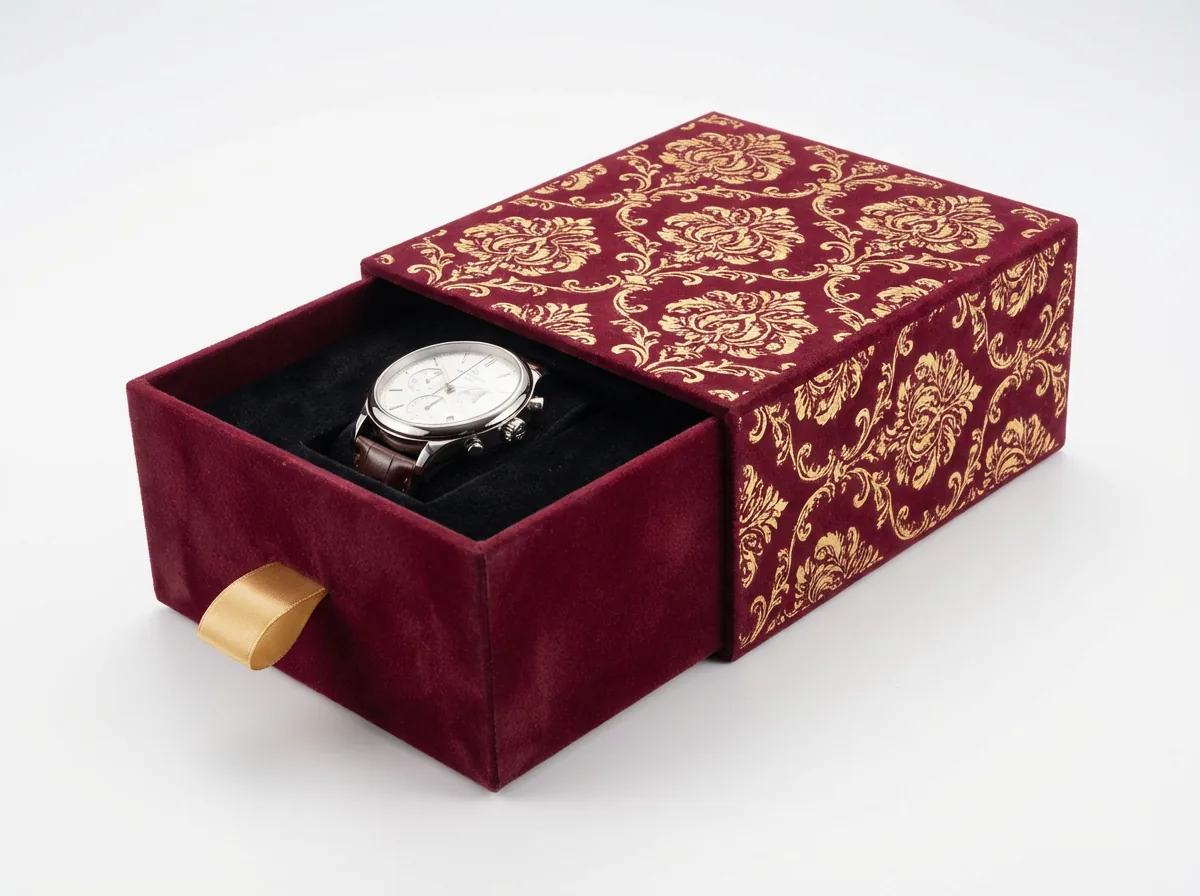
Sliding Drawer Box
Sleeve and tray with a ribbon pull; the product slides into view.
From 100 pcs · best price 500+View product →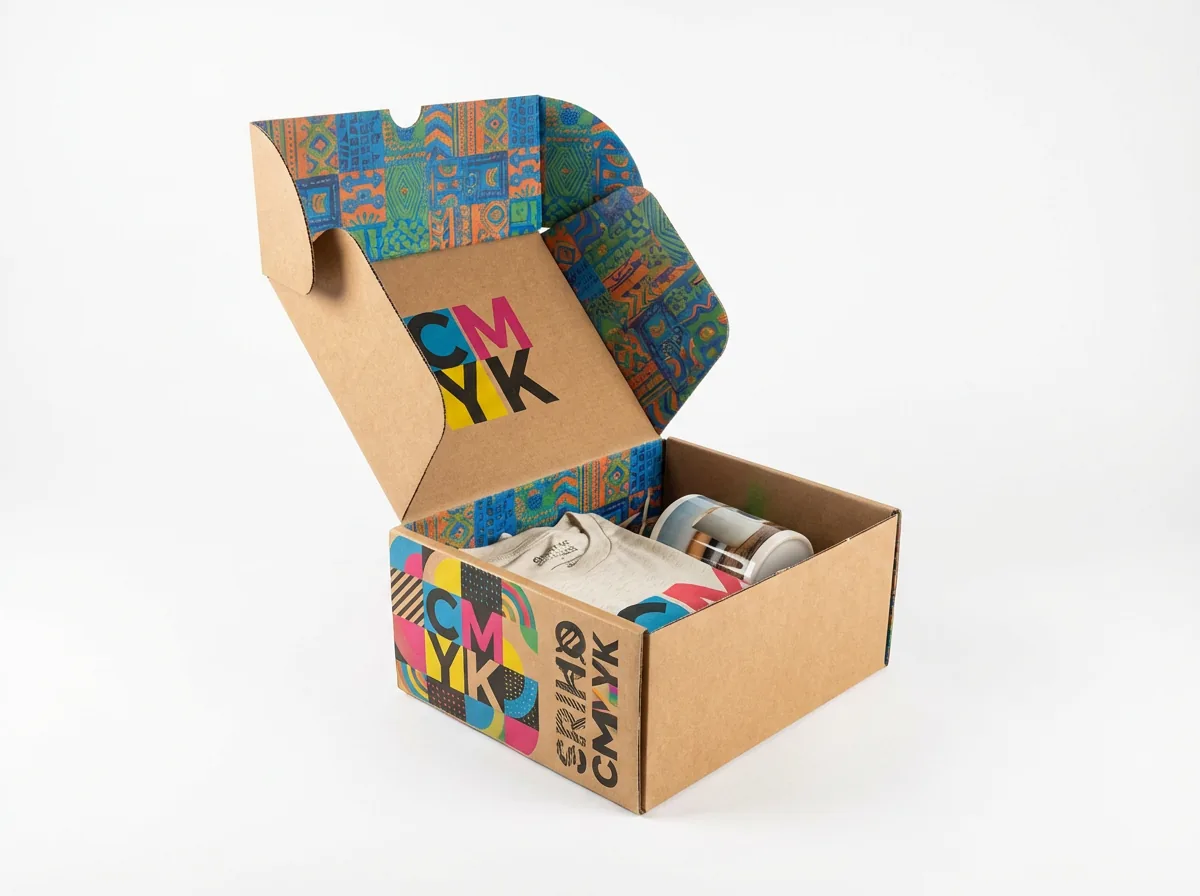
Corrugated Mailer with Tear Strip
Printed shipping box that opens on a tear strip.
From 300 pcsView product →Ready to price one of these? Send a quote request — the reply includes a free 3D mockup.
Questions
Are box dimensions inside or outside measurements?
Ask which one every time. A packaging factory sizes a custom box from the interior (the cavity your product sits in), while couriers and warehouses bill and stack by the exterior. On a rigid gift box the two differ by about two board thicknesses on each axis.
What order do L × W × H go in?
Length and width describe the opening, length being the longer side; height (or depth) is the dimension at right angles to the opening. So a 200 × 150 × 50 mm box opens on a 200 × 150 mm face and is 50 mm deep.
How much bigger than my product should the box be?
Interior = product + the clearance you agree on both sides of every axis. Our worked example uses 3 mm per side (a 90 × 60 × 30 mm product needs a 96 × 66 × 36 mm cavity); that is an example, not a universal tolerance. Inserts, velvet pads and fabric wraps need room on top of the clearance, so size from the insert, not the bare product.
How do I measure the outside of a box?
Measure across the widest points, including the lid if it overhangs the base, with a rigid ruler or caliper rather than a tape. For quoting before a sample exists, estimate exterior ≈ interior + two board thicknesses per axis, then record the measured size of the approved sample.
What does 12 × 12 × 12 mean on a box?
It is length × width × height: 12 inches long, 12 inches wide and 12 inches high, a cube of about 305 mm on each side. Check whether the seller means inside or outside; on a shipping box it is usually the inside, on a courier label the outside.
Is height the same as depth on a box?
Yes. On a box, height and depth both mean the dimension at right angles to the opening. Depth is the more common word for drawer boxes and trays, height for upright cartons; either way it is the third number in L × W × H.
How do I measure a box for shipping?
Measure the outside of the packed box at its widest points, including any bulge, handle or lid overhang. UPS and FedEx round each side up to the whole inch and divide L × W × H by 139 to get dimensional weight in pounds; you pay the greater of that and the actual weight.
How do I convert box dimensions from inches to mm?
Multiply each side by 25.4. For example 8 × 6 × 2 in is 203.2 × 152.4 × 50.8 mm, written 203 × 152 × 51 mm. Keep the interior or exterior label, and round an interior up rather than down so the product still fits.