Stop the Crush: How to Reduce Shipping Costs and Prevent Packaging Damage in 2026
Buyer answer: Reduce shipping damage by diagnosing the observed failure before changing the presentation box. Restrain product movement, cushion shocks, use a route-appropriate corrugated outer carton and support vulnerable panels or corners as separate functions. Then compare packed dimensions and weight under the actual carrier service, and validate the complete loaded pack with a documented sample-test plan. No material or test can promise damage-free delivery.
Shipment-readiness decision framework
Approve a packaging design only after you can review evidence for product fit, protection, packed-carton dimensions and the handoff to fulfillment. Start with the actual product, route and observed failure rather than a universal board-grade rule.
- Measure: confirm the product fit with the gift box size guide, then request outer and master-carton dimensions.
- Protect: ask for the proposed board, wrap, insert and outer-shipper specification; use the materials guide to describe the build.
- Model: compare the packed carton with the dimensional-weight guide, not a generalized freight-saving claim.
- Handoff: ask the 3PL or fulfillment partner to confirm labeling, carton handling and receiving needs with the 3PL-ready checklist.
Use the price guide and quote request to compare a written scope. The final specification should identify assumptions that require a sample, packing test or carrier confirmation.
Diagnose crush and scuff marks differently
| Observed failure | Likely mechanism to investigate | First evidence to collect | Possible response to prototype |
|---|---|---|---|
| Crushed panel or collapsed corner | Compression, unsupported span, overload, poor stack pattern or outer-carton weakness. | Failure location, packed mass, carton orientation, stack height, corrugated specification and route handling. | Adjust outer carton, add corner or panel support, reduce unsupported space, or change the master-carton pack-out. |
| Scuffed wrap or printed surface | Rubbing against product, insert, adjacent box or shipper during vibration and handling. | Contact pattern, free movement, wrap/finish sample, separators and where abrasion appears. | Restrain movement, isolate surfaces, change contact materials or add a protective sleeve or separator. |
For a crush, investigate compression, support, stack pattern and possible moisture-related weakening. For a scuff, investigate contact points and movement. Treating both as “use thicker board” can add cost without addressing the observed mechanism.
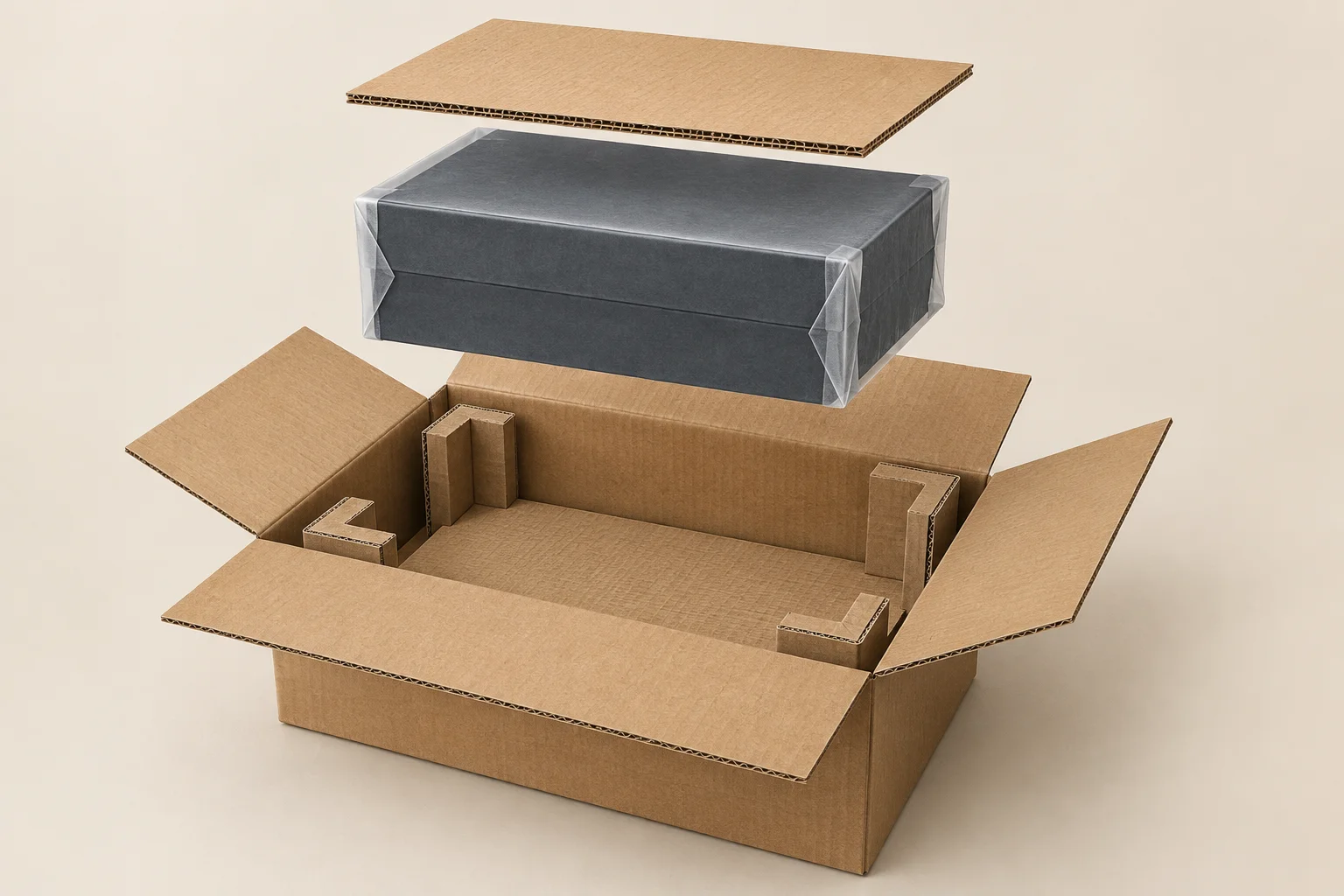
Assign restraint, cushioning, outer carton and support
- Restraint limits movement so the product does not strike the box or abrade sensitive surfaces. Check all intended orientations and removal clearances.
- Cushioning manages shocks and vibration. Specify where it acts, how it is retained and whether it changes after repeated handling.
- Outer carton carries parcel labels and takes distribution handling, stacking and compression loads. The presentation box should not silently inherit this role.
- Panel and corner support routes loads around vulnerable faces and gaps. Verify the loaded geometry, not just board names or nominal thickness.
Board choice cannot be set from box length or a generic “budget” versus “premium” label. Product mass, geometry, insert, outer carton, stack pattern and route all affect the required specification.
Turn failures into a sample-test plan
Write the plan before testing. Identify the controlled product revision, pack components, conditioning if relevant, test sequence, orientations, inspection points, acceptance criteria and who can approve a deviation. Use enough samples to investigate variation rather than treating one undamaged parcel as proof.
A practical development sequence can include loaded fit and movement checks, controlled drops in relevant orientations, vibration or transport simulation, compression or stacking evaluation, then cosmetic and functional inspection. Select procedures from the product's hazards and distribution system. ISTA advises using known distribution requirements and packaged-product characteristics to choose an appropriate approach; it does not prescribe one universal test for every gift box.
If the product, mass, center of gravity, insert, box dimensions, materials, assembly or route changes, review whether earlier evidence still applies. Record failures and changes by revision, then retest where the change may affect performance.
Model freight after protection is defined
Measure the final corrugated shipper containing the product, insert, presentation box and all protection. Ask the named carrier or forwarder to quote the intended origin, destination, service, dimensions and gross weight. Dimensional-weight formulas and divisors vary by carrier, unit convention and service; there is no universal divisor.
Compare any size reduction against the protection removed. A smaller shipper is useful only if the revised loaded system meets the project acceptance criteria. For flat-packed packaging arriving from the supplier, keep empty inbound transport separate from the assembled outbound parcel; the foldable magnetic box guide shows that comparison.
Redesigning a shipper to cut damage, freight and storage: a five-step check
- Record the failure first. Photograph crushed corners, scuffs and loose products from real returns before changing any specification.
- Stop movement inside the box with an insert or divider before adding cushioning or a heavier carton.
- Size the outer carton around the packed presentation box, then re-check dimensional weight with the carrier.
- Test the revised loaded system — product, insert, box and shipper together — to the transit test your carrier or retailer names, such as an ISTA procedure.
- Lock the approved pack-out as the repeat-order spec, so reorders ship in the same tested configuration.
Sources and evidence boundary
FedEx explains dimensional weight and provides guidance on weight-based pricing and service-specific dimensional-weight rules; both need to be checked for the actual shipment. The UPS packaging guidelines describe packaging functions such as cushioning, movement control and corrugated containers. ISTA's design and testing guidance supports route- and product-specific test planning. These sources guide a method; they do not promise an outcome for a particular shipment.
Build a Route-Specific Packaging Brief
Send the product, destination, packing route and current failure. Request a written proposed specification and the evidence needed before bulk approval.
Chat with a Factory Expert