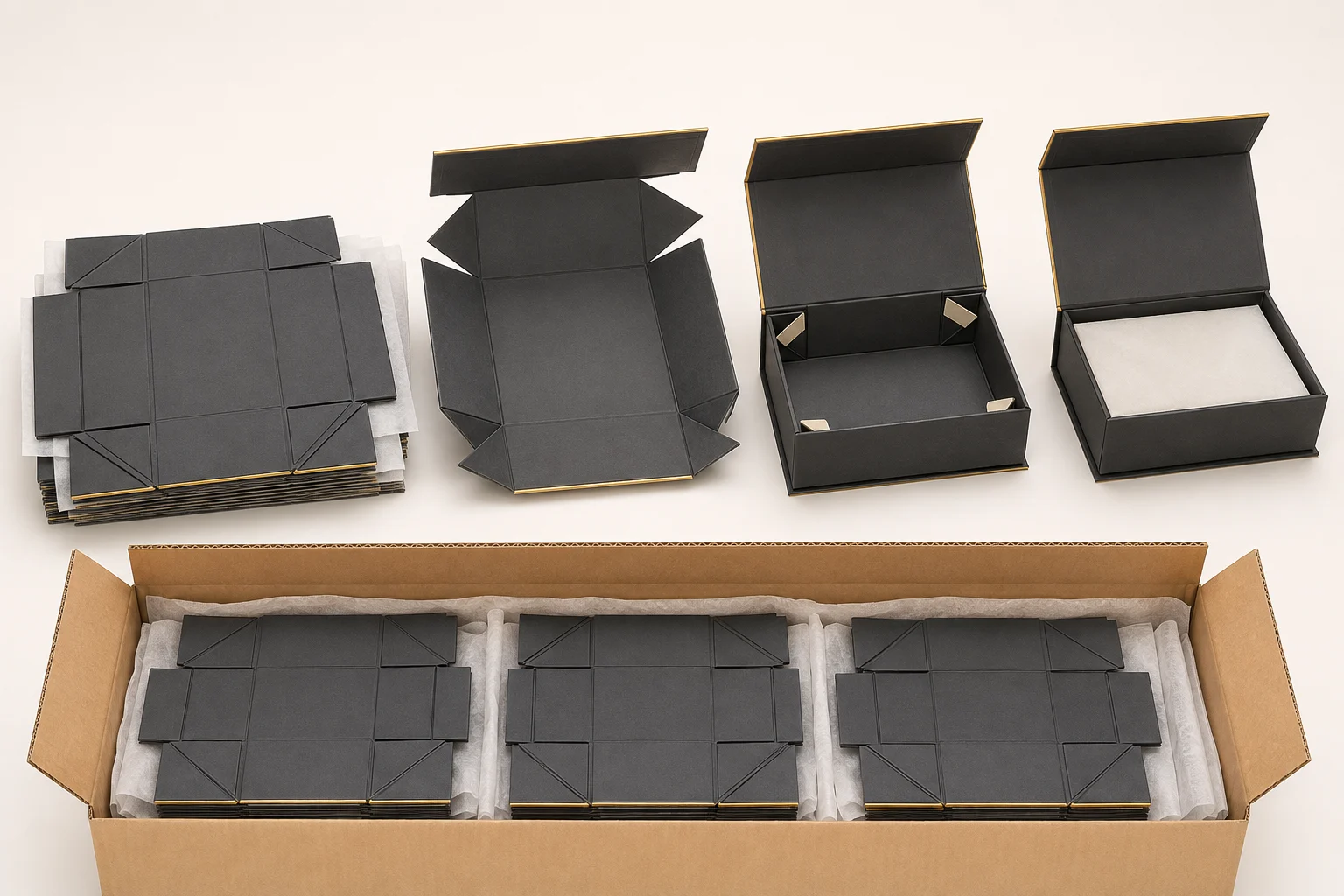
Assembly and shipping specification reviewed .
A collapsible magnetic box is supplied flat and assembled before filling. It suits projects that can handle assembly at the destination and need to compare storage or shipped volume. Approve the fold sequence, finished fit, units per carton and actual packing dimensions together; flat packing alone does not establish a freight saving.
Compare Flat-Pack Freight
A useful freight comparison needs measurements of the finished box, supplied folded unit and packed export carton for the same project. An opened-panel drawing or dieline is not the folded-unit shipping size. Use this checklist in the RFQ and sample approval.
| Checkpoint | Supplier should state | Buyer approval |
|---|---|---|
| Assembly | Fold sequence, scored panels, magnetic flap and corner reinforcement | Open, square and close the sample repeatedly without panel lift |
| Dimensions | Interior/exterior finished size, supplied folded-unit length, width and thickness, plus insert clearance; keep dieline dimensions separate | Packed product fits with the intended presentation and protection |
| Transport | Flat or assembled basis, pcs/carton, carton L×W×H, gross/net weight, destination and Incoterm | Compare identical quantities, destinations and service levels using measured carton data for each format |
Download the blank flat-pack and assembled-carton worksheet (CSV). Record sample ID, revision, measurement date, packing mode, units per carton and measured outer carton dimensions. Carton CBM = L x W x H / 1,000,000,000 for mm, or / 1,000,000 for cm; total CBM is the sum across all cartons. Do not infer freight savings from CBM alone. Check the carrier's chargeable-weight rules and destination assembly work. Measure the loaded fit, select the insert and wrap, and use the same-specification quote comparison. Request a written specification review or compare the standard magnetic rigid format.
Straight answers from our factory team — MOQ, lead time, finishes and protection.
The box ships flat-packed and is assembled on demand, which can reduce shipment volume and storage needs compared with pre-assembled rigid boxes. The actual freight effect depends on carton dimensions, packed quantity, destination, and carrier rules.
The listed starting MOQ for this collapsible magnetic format is 300 pieces. Confirm the selected size, wrap, finish and insert against that quantity in the written quotation; it is not a company-wide minimum.
Options include gold foil stamping, embossing, debossing, spot UV, soft-touch matte and gloss lamination, CMYK offset printing, and ribbon accents, all with a luxury magnetic closure.
Confirm whether the sample is structural, printed or production-equivalent, then request its cost and timing. Bulk scheduling depends on material readiness, quantity and sample approval; use the dates confirmed for your project rather than a universal lead time.
The flat-packed panels are opened along the scored fold lines, the side walls are squared and secured, and the magnetic flap is closed to check alignment. Approve the assembly sequence and corner finish on a physical sample before bulk production.
Provide the packed product length, width, height, weight and required insert clearance. Request interior and exterior finished dimensions, the supplied folded-unit length, width and thickness, and packed-carton dimensions. Keep opened-panel or dieline dimensions separate from the folded unit used for shipping.
Confirm whether the quote is for flat-packed or assembled units, carton dimensions and quantities, gross and net weights, destination, Incoterm such as EXW, FOB or DDP, and any carrier or moisture-protection requirements. Freight savings depend on those inputs.