Subscription commerce has a packaging problem that one-off e-commerce doesn't: you buy the box again every month, for every subscriber, forever. At 2,000 subscribers and a $1.10 mailer, packaging is a $2,200 line item that recurs twelve times a year — $26,400 before a single product goes inside. Shave thirty cents a unit and you've found $7,200 a year; let the box creep one size too big and DIM-weight shipping quietly takes it back double.
So this guide treats subscription packaging the way your P&L does: as a recurring unit cost with three levers — print method, box size, and order cadence — plus one revenue lever most operators underprice: the box is the only physical touchpoint your brand has, and it shows up on camera every month. Here's the 2026 math on all four.

Where these numbers come from: unit-cost ranges below combine 2026 US wholesale pricing guides with our own EXW factory quotes. They're planning figures — artwork coverage, board grade and destination move them. The pattern that never changes: volume is the biggest price lever (a 10,000-unit run prices 50-65% below a 500-unit run per 2026 wholesale data), and buying factory-direct removes the 20-40% that distributors and trade printers layer on the same box.
The three packaging tiers, and where each belongs
Most successful programs don't pick one — they ladder: a printed mailer for the monthly cycle, a rigid box for the first shipment or the holiday edition, because the first unboxing decides whether month two gets an unboxing at all. If your box price sits above $75, look at the rigid construction class; everything else starts as corrugated.
What subscription packaging costs in 2026
| Spec | Typical 2026 unit cost | Economic from | Notes |
|---|---|---|---|
| Stock kraft mailer + branded sticker/tissue | $0.25 – $0.60 all-in | Any volume | The under-300-subscriber play |
| Digitally printed custom mailer | $0.40 – $1.20 | 100–500 pcs | No plates; art can change monthly |
| Flexo-printed mailer (1–2 colors) | $0.60 – $1.00 | 1,000 pcs | Plate cost amortizes fast |
| Litho-laminated full-coverage mailer | $1.20 – $3.00 | 5,000 pcs | Magazine-quality print inside and out |
| Rigid box (luxury tier) | $3.50 – $8.00 | 100 pcs | Factory-direct rigid starts ~$3.50 |
Live factory anchors to calibrate against: our custom mailers start around $0.85 EXW with MOQs of 300-500 pieces, and volume steps at roughly −15% at 500 units, −25% at 1,000, −40% at 5,000, −50% at 10,000. EXW means at the factory door — ocean freight and duties ride on top, and for US buyers the landed-cost guide walks that math. The general cost mechanics of box buying — what drives price up and down — are in our custom gift box cost guide.
The DIM-weight math that outweighs your print savings
US carriers bill the greater of actual weight and dimensional weight: length × width × height in inches, divided by 139 on standard retail rates. Run the numbers on two real candidates for the same contents:
- 12 × 9 × 4 in box: 432 cu in ÷ 139 = 3.1 → billed as 4 lb
- 10 × 8 × 3 in box: 240 cu in ÷ 139 = 1.7 → billed as 2 lb
If the contents weigh 1.5 lb, the bigger box costs you two billable pounds on every single parcel — commonly $1.50-3.00 per shipment depending on zone. At 2,000 boxes a month, that's $3,000-6,000 a month for air inside a box, which dwarfs anything you'll save negotiating print. It's the same lesson a much-upvoted r/shopify post reached after a founder re-boxed an oversized product: the custom-sized box, not the shipping rate, was the discount. Right-size ruthlessly: measure your true monthly contents envelope, add 10-15 mm of working room, and stop. Void fill is a tax you pay for a box that's too big — our shipping cost guide goes deeper on parcel optimization.
Specs that survive twelve months of couriers
The standard construction is a roll-end front-tuck mailer (the fold-open style with locking side flaps) in corrugated board, typically 32 ECT. Your two board decisions:
- E-flute (~1.5 mm): crispest print surface, trimmest parcel — the default for cosmetics, snacks, lifestyle goods.
- B-flute (~3 mm): noticeably more cushion — choose it for glass jars, candles, or anything over ~2 kg, and pair it with a divider or insert (our insert comparison guide covers which).
Two features earn their pennies at subscription scale: a tear strip, so opening is one motion and no subscriber takes a box cutter to your products, and a second peel-and-seal strip if your model involves returns or swaps — the same box goes back without tape. White-top kraft reproduces brand colors accurately; brown kraft prints fewer colors well but leans into the eco read. Both are on display in our recycled kraft mailer.
The unboxing choices that show up in retention
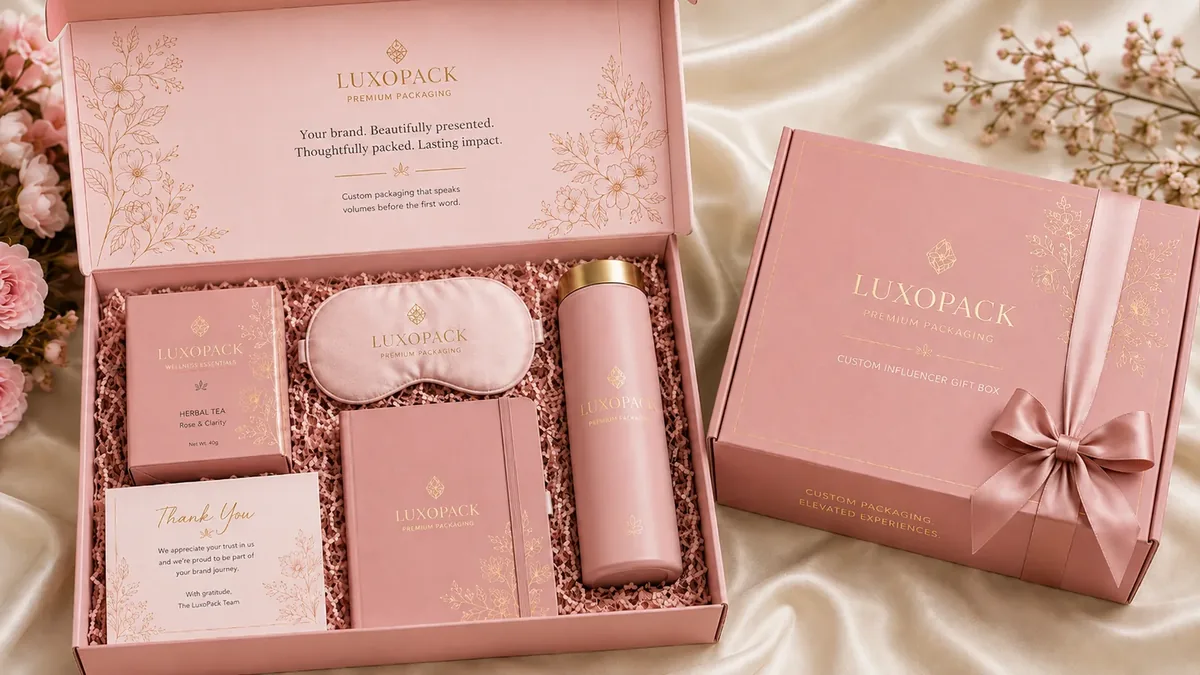
Subscribers churn silently, and the box is your monthly argument against it. The upgrades that earn their cost, in rough order of impact per dollar:
- Interior flood print. The outside gets 2 seconds on a doorstep camera; the inside gets the whole unboxing video. Printing the interior costs little at litho-lam volumes and transforms the reveal.
- Tissue + sticker ritual. Cents per box, and it forces a two-beat opening — anticipation is the product.
- A card with a job. Not "thank you" — a QR to next month's teaser, a founder note, a use-this-first instruction. Give the camera something to read.
- Eco signals subscribers can verify. Recyclable kraft, FSC certification, plastic-free interior. In subscriber communities like r/SubscriptionBoxes, eco-friendly packaging is one of the few packaging attributes members praise unprompted — and its absence gets photographed too. If sustainability is your angle, our eco mailer sourcing guide maps the credible options.
The consistency trick: keep the dieline and structural spec identical every month, and rotate the theme through cheap variable layers — sleeve, sticker sheet, tissue color, or a digitally printed top sheet. Plates and tooling stay amortized; the box still feels new. (Why the reveal works on the brain at all: the science of unboxing.)
Sourcing cadence: buying boxes like inventory
Monthly shipping volume changes how you buy. The pattern that works at 500+ subscribers:
- Blanket order, monthly releases. Commit 3-6 months of volume at one price break (say 10,000 units priced as 10,000), and have the factory produce and release monthly. You get the volume price without warehousing a year of boxes.
- 1.5 cycles of buffer stock. Growth spikes and freight delays both eat buffer; 1.5 months' worth is the working minimum before reorder anxiety sets in.
- Reorder clock: 12-15 days production after artwork approval + 25-35 days ocean to the US. Call it 7 weeks door-to-door on repeat orders; first orders add sampling. Full timeline anatomy: lead times explained.
- Calendar risk: Q4 holiday production and Chinese New Year (February 6, 2027) both compress factory capacity — the boxes for your January and February cycles need POs by roughly October.
When to upgrade (a subscriber-count cheat sheet)
| Stage | Packaging play | Why |
|---|---|---|
| Under ~300 subscribers | Stock kraft mailer + branded tissue, sticker, card | Custom print MOQs strand cash; ritual reads custom anyway |
| ~300 – 1,000 | Digitally printed custom mailer | No plate costs; interior print becomes affordable at 500+ |
| 1,000 – 5,000 | Flexo or litho-lam at blanket-order pricing | Unit cost drops steeply; lock a dieline, rotate variable layers |
| Premium / gift tier at any size | Rigid box (MOQ 100) | First-box and holiday editions convert at rigid quality |
Price your subscription mailer against your real dieline
Send box dimensions and monthly volume; we'll quote EXW at three quantity breaks (with interior print priced separately so you can see the delta), plus a pre-production sample in 3-5 days. Mailers from $0.85, MOQ 200.
Get my mailer quoteThe checklist before your next packaging PO
- Re-measure the contents envelope against the current box; if there's more than 15 mm of slack in any dimension, you're buying air at DIM rates.
- Run the DIM calculation (L×W×H ÷ 139) on the current and right-sized box; multiply the billable-pound delta by monthly volume before you look at print quotes.
- Pick the tier by box retail price — kraft under $25, printed mailer $30-60, rigid for $75+ or first-box moments.
- Spec E-flute vs B-flute by fragility, and add the tear strip.
- Quote at three volumes (this month's, 3×, 10×) so you can see your own price curve and decide where a blanket order pays.
- Lock the dieline, rotate the theme through sleeves, stickers and tissue instead of new tooling.
- Check the calendar — POs for Q4 and Q1 boxes need to clear before the holiday/CNY capacity squeeze.
Subscription packaging rewards operators who treat it as a system: one right-sized dieline, one protective spec, one monthly ritual, bought at the deepest honest volume break. Set that up once and the box becomes what it should be — the cheapest retention tool you own.
Frequently Asked Questions
LuxoPack produces subscription mailers and rigid boxes factory-direct in Shenzhen — mailers from $0.85 EXW, rigid from 100 pcs, blanket-order scheduling available. Related reading: Subscription Box Packaging Solutions, Custom Gift Box Cost Guide, Chinese New Year 2027 Order Deadlines, Eco-Friendly Mailer Sourcing, The Science of Unboxing.