Buyer answer: Start with a stock-size box plus a label or printed sleeve when demand, artwork or product-market fit is still uncertain and a suitable size protects the product without excessive filler. Compare a fully custom gift box once demand repeats, branding and fit matter more, or recurring labor and packing waste offset the lower first-order commitment. Decide with total first-order cash and inventory exposure, not the quoted box price alone.
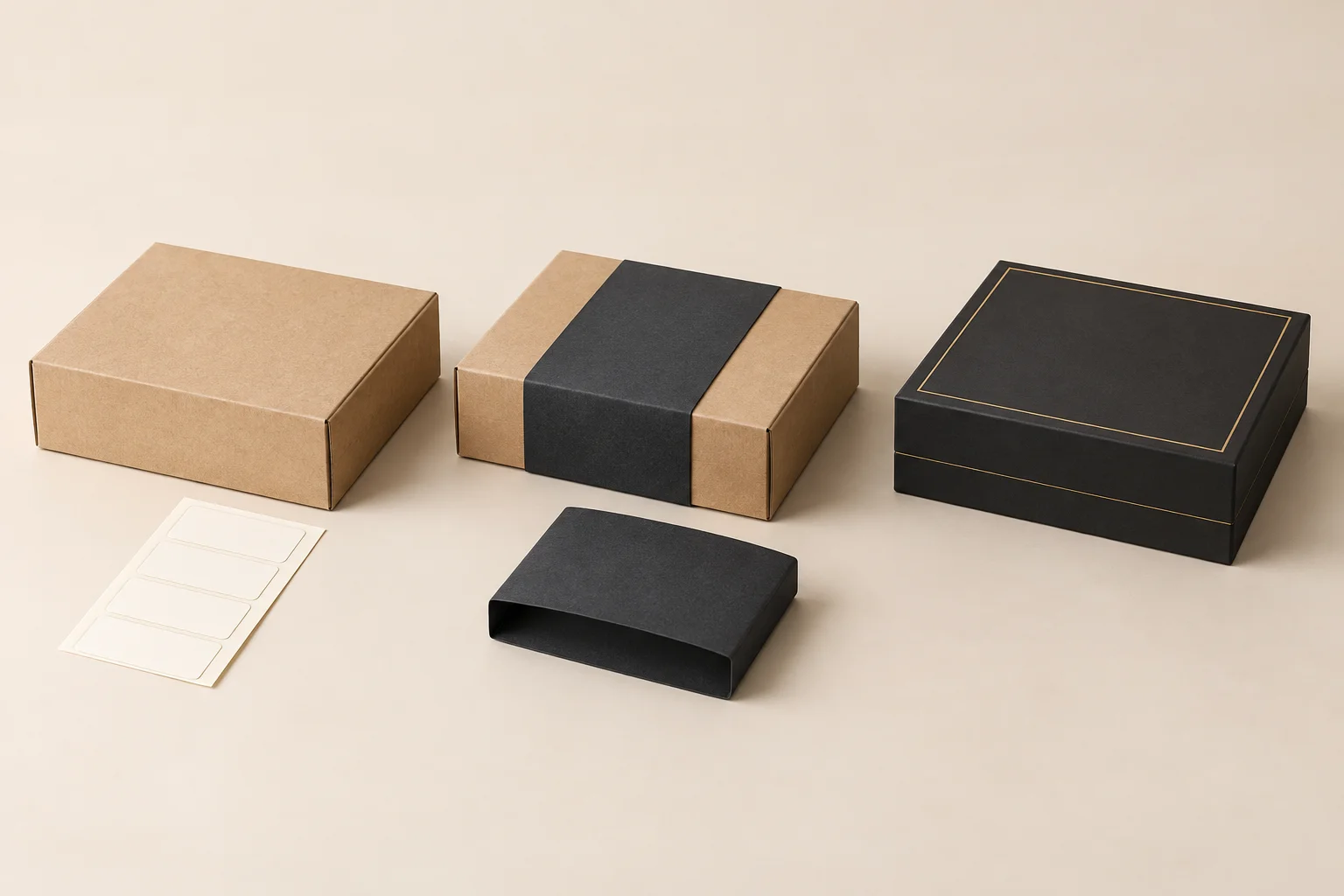
Compare stock-plus-branding with fully custom
| Decision factor | Stock box + label or sleeve | Fully custom gift box |
|---|---|---|
| Commitment | Can limit the branded component to labels or sleeves while the box size remains standard. | Commits cash to a product-specific structure, print and finish run. |
| Fit | Accepts the nearest available size; include filler, insert and outbound shipper consequences. | Can be engineered around the product and opening sequence after dimensions are frozen. |
| Brand control | Branding is concentrated on applied labels, cards or sleeves; application accuracy becomes a packing step. | Structure, printed area and finishes can be coordinated, subject to proof and sample approval. |
| Change risk | A label or sleeve revision may leave the unbranded boxes usable if size and condition still fit. | A product, artwork or regulatory change can strand product-specific packaging. |
| Operations | Count label or sleeve application, alignment, filler and kitting labor every order. | Count receiving, storage, assembly where applicable and quality inspection. |
“Stock” does not automatically mean available locally, available in small quantities or suitable for a luxury pack. Verify size, material, finish, inventory, replenishment and delivery terms with the stock-box vendor. This guide does not assert that LuxoPack supplies stock boxes or local short runs; the LuxoPack quote form is an entry point for a defined custom-packaging scope.
Calculate total first-order cash
Normalize both options to the same product quantity, destination, route and acceptance criteria. Keep cash timing visible if deposits, balances or separate suppliers are involved.
Use current written quotations rather than an illustrative unit price when comparing commitments. Ask each party to label what is included, excluded or provisional. The custom packaging price guide explains how to normalize scope, while the custom gift box MOQ guide separates production minimums from assumptions about the “best” order size.
Separate unsold inventory from consumed-per-order cost
Unsold inventory exposure is the cash tied up in packaging that remains after a launch, forecast change, product revision or artwork change. Estimate it by scenario: likely units sold before the change, remaining usable unbranded boxes, remaining obsolete labels or sleeves, and remaining fully custom boxes. Do not count all remaining stock as a loss if it has a defined reuse path.
Consumed-per-order inputs are different. Every fulfilled order may use one box, one sleeve, a label, filler, tape, labor and an outer shipper. These affect repeat unit economics even when no inventory becomes obsolete. A stock route can lower exposure yet remain labor-heavy; a custom route can reduce recurring pack-out steps yet expose more branded inventory.
When to switch to fully custom packaging
Requote the decision when the product and artwork are stable, orders repeat, forecast error has narrowed, or the same stock fit creates recurring filler, labor, dimensional-weight or presentation problems. Also compare custom when product restraint, premium opening sequence or retail consistency cannot be achieved with a standard size.
Do not switch on sales volume alone. Compare annual demand by variant, reorder cadence, lead-time buffer, storage capacity and the cost of change. A pilot or seasonal launch may still favor stock-plus-branding even at meaningful volume, while a stable hero product may justify custom earlier. For small-brand planning, see the custom gift boxes for small business guide.
RFQ checklist for an apples-to-apples decision
- Product dimensions, weight, orientation, fragile zones and finished sample status.
- Required internal fit, insert or filler, opening sequence and outer shipper.
- Forecast by product and artwork variant, plus reorder cadence and launch date.
- Stock-box size and availability evidence; proposed label or sleeve dimensions and application method.
- Custom structure, print and finish scope, sample gates and quoted production quantity.
- Packing location, labor method, destination, route, delivery window and storage constraints.
If custom packaging will arrive folded, add measured inbound cartons and destination assembly to the comparison using the foldable magnetic box guide. For the loaded outbound pack, use the shipping damage guide.
Buyer questions and sources
A public Reddit ecommerce discussion surfaces buyer concerns about validation, quantities and inventory. It is a question signal, not supplier-capability, price or performance evidence. The formulas and decision gates above must be populated with the buyer's current vendor quotes, forecast and operating data.
For the loaded pack, FedEx's dimensional-weight explanation supports checking service-specific billable weight, while ISTA's packaging design guidance supports evaluating product, package and distribution together. Neither source determines which buying route is cheaper.
Frequently Asked Questions
Ready to compare a defined custom option?
Send product dimensions, quantity by variant, finish intent, destination and required date. Ask for assumptions and exclusions in writing.
Request a Custom Packaging QuoteRelated: browse custom packaging products and prepare the same inputs for every supplier under review.