For a US retail cosmetic carton, start with the product identity and net quantity on the principal display panel, then reserve an information panel for the business identity, ingredient declaration and any product-specific warnings. MoCRA also requires a domestic address, domestic phone number or electronic contact through which the responsible person can receive adverse-event reports. EU and Great Britain requirements are separate: both include a Responsible Person framework, and products with minimum durability over 30 months generally use period-after-opening information where that concept is relevant.
This guide walks through each element in plain terms so you can hand your factory a dieline that already reserves room for the mandatory copy, instead of discovering at the artwork-proof stage that the ingredient block won't fit. One caveat up front, and it runs through everything below: regulations change and the exact wording, figures, and thresholds cited here are illustrative. Before you commit a print run, confirm the current requirements for your specific product and markets with a regulatory consultant or counsel.
Scope: This is a packaging-space and artwork-planning guide, not legal advice or approval of a finished label. The responsible person and its regulatory adviser should confirm the current rules, product classification, formula-specific warnings and market language before printing.
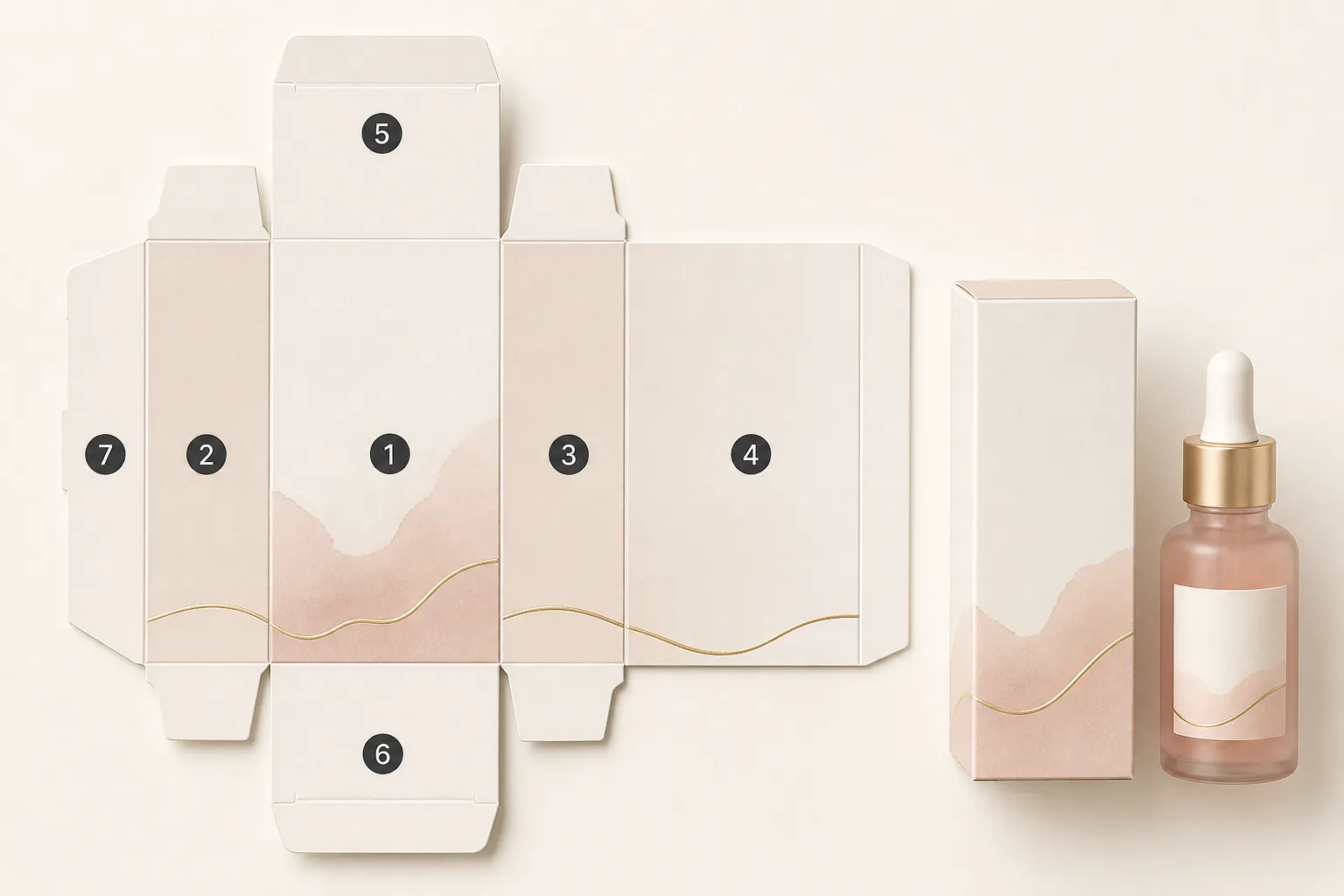
The 2026 cosmetic label at a glance: what legally has to be on the box
For a product sold in the United States, begin with the FDA's summary of cosmetic labeling requirements, the linked 21 CFR Parts 701 and 740, and MoCRA. Country-of-origin marking comes from US customs rules rather than this FDA cosmetics list, so confirm it separately for the finished imported article.
US required elements: identity, net quantity, name & place, warnings, country of origin
The statement of identity and the net quantity of contents both belong on the principal display panel — the face of the box the customer sees on the shelf. Net quantity is conventionally shown in both US customary and metric units. The name and place of business — the manufacturer, packer, or distributor — can sit on an information panel (a side or back panel). Country of origin is a customs requirement; for a box made in our Shenzhen factory and sold in the US, that generally means a clear "Made in China" marking.
Warnings are product-specific. Some cosmetics carry a statutory caution; others need none. This is exactly the kind of line-item a regulatory consultant should confirm for your formula, because a missing required warning is a labeling defect the same way a missing ingredient is.
The practical point for a box buyer: these elements compete for panel space with your brand design. On a small carton, the front panel fills up fast once identity and net quantity are placed, which pushes the ingredient block and business details onto the side and back panels. Decide that layout before the dieline is cut, not after.
The INCI ingredient list: descending order, and when it can move to the outer carton
Use ingredient names accepted by the market where the product will be sold, not marketing descriptions. In the US, FDA requires the ingredient declaration in descending order of predominance, with specific exceptions for colour additives and ingredients at one percent or less. EU and GB ingredient naming and ordering should be checked against their current cosmetics rules. Have the responsible person approve the final declaration rather than asking the box factory to infer it from a formula.
In the US, FDA says the ingredient declaration may appear on an information panel of the package, including a folding carton when the immediate container is boxed; narrowly defined off-package alternatives apply to certain very small products. EU and GB rules have their own container, packaging and leaflet provisions. Treat the carton as part of the label system, but confirm exactly where each statement must appear for the target market and how the product is presented for sale.
| Element | Where it normally lives | Can it move to the outer box? |
|---|---|---|
| Statement of identity | Front (principal display) panel | Stays on the display panel |
| Net quantity | Front panel, bottom 30% | Stays on the display panel |
| Ingredient declaration | Information panel under the applicable market rules | Often on a folding carton; limited alternatives require market-specific confirmation |
| Name & place of business | Information panel | Yes, information panel of carton |
| MoCRA adverse-event contact | Label | Yes, on the outer carton label |
LuxoPack prints and finishes these cartons in Shenzhen; label copy, INCI panels and PAO symbols are checked against your artwork before tooling is cut, from 100 pcs.
What MoCRA (2022) changed for the box in 2026 — and where the fragrance-allergen rule stands
The packaging change buyers need to reserve space for is the MoCRA contact line: FDA states that each cosmetic product label must include a domestic address, domestic phone number or electronic contact information through which the responsible person can receive adverse-event reports. An electronic contact may be a website. A company outside the US may still be the responsible person if it meets the statutory definition; do not turn this label line into a claim that every foreign brand must appoint a US-based responsible person.
Fragrance-allergen space: MoCRA directs FDA to determine fragrance allergens by regulation. Because the resulting requirements depend on that rulemaking, keep the artwork flexible and check the current FDA status before approving a print run.
EU and Great Britain: PAO, Responsible Person and small-package rules
The EU Cosmetics Regulation uses a date of minimum durability for products up to 30 months. For products with minimum durability over 30 months, it requires period-after-opening information except where that concept is not relevant, such as certain single-use, non-opening or non-deteriorating products. Great Britain has its own Responsible Person and notification regime; current GOV.UK guidance should be checked separately rather than treating “EU/UK” as one legal market.
A shared dieline can reserve enough panel space for multiple markets, but the final artwork should not be assumed interchangeable. Responsible Person details, mandatory language, ingredient presentation, durability information and warnings may differ. Decide between one controlled multilingual artwork and market-specific versions with the responsible person and regulatory adviser.
Minimum type height and legibility — why tiny print gets rejected
Mandatory copy has to be prominent and legible. FDA states that US ingredient declaration letters generally must be at least 1/16 inch high, with a 1/32 inch provision when the total package surface available for labeling is less than 12 square inches. Other required statements use their own rules, so do not apply this ingredient-text measurement to the whole artwork without checking the relevant provision.
Why this matters at the factory stage: designers routinely shrink the ingredient block to reclaim space for the logo, and printers can only hold so much detail in tiny reversed-out (light-on-dark) type before it fills in and becomes unreadable. If your INCI list is set below the legible minimum, the whole label can be rejected even though every required word is technically present. Two fixes at the dieline stage — give the ingredient panel more room, and avoid setting fine legal copy in reverse or over a busy pattern — prevent most of these problems.
Carton vs sticker vs leaflet: where each mandatory element is allowed to live
You have three surfaces to distribute the required copy across, and each has trade-offs.
An applied label may be workable, but placement, permanence, prominence and permitted label surfaces are market- and statement-specific. A leaflet is not a universal escape route for crowded artwork. Map every required statement to its permitted location, then have the responsible person approve that map before the factory creates the final proof.
What to hand your factory so the dieline reserves space for compliant copy
The single biggest time-saver is giving your box maker the compliance requirements before the dieline is finalized, so the layout reserves real estate for the ingredient block, the business address, and the MoCRA contact from the start. Hand over:
- Your approved ingredient declaration exactly as it must print (character count determines how much panel space it needs).
- The net quantity in both unit systems and your statement of identity.
- Name and place of business and the US adverse-event contact string.
- Which markets the SKU ships to, including EU and Great Britain separately, so the correct Responsible Person, language and durability information can be reserved.
- Any required warnings your consultant has confirmed, and your country-of-origin marking.
With that in hand, the dieline can be drawn so the legal copy sits at a legible size on the right panels, and your brand design fills the space that's actually left — instead of a last-minute fight to cram ingredients into a corner. For deeper detail on how artwork and dielines fit together, our print-ready artwork and dieline guide covers the file-prep side.
Reserve the right panel space before artwork approval
Send the buyer-approved label copy, target markets and product dimensions. LuxoPack can build the dieline around that content and produce a pre-production sample; the responsible person retains regulatory approval.
Ask about the carton dielinePre-print compliance checklist before you approve artwork
- Statement of identity and net quantity are on the front panel, net quantity in both US and metric units.
- The ingredient declaration uses names and ordering approved for the target market, including any applicable exceptions.
- Name and place of business are shown; country of origin is marked.
- MoCRA US adverse-event contact (phone or electronic) is on the label.
- Any required warnings your consultant confirmed are included and correctly worded.
- If selling in the EU or Great Britain: durability/PAO, Responsible Person, language and ingredient placement have been checked for that market; PAO exceptions have been considered.
- Each mandatory statement meets its applicable prominence and legibility rule; US ingredient text is checked against 21 CFR 701.3.
- Every statement has been mapped to a permitted panel, package, label or leaflet location for the way the product will be sold.
- You have signed off with a regulatory consultant or counsel on the final artwork — every figure and rule above is illustrative and current requirements must be verified with the relevant agency before printing.
Frequently Asked Questions
Official sources checked for this update
- FDA: Summary of Cosmetics Labeling Requirements
- FDA: Modernization of Cosmetics Regulation Act of 2022
- EUR-Lex: Regulation (EC) No 1223/2009 on cosmetic products
- GOV.UK: Making cosmetic products available in Great Britain
LuxoPack manufactures custom rigid and folding cosmetic cartons in Shenzhen. We can reserve panel space and produce artwork proofs from buyer-approved copy, but the responsible person remains responsible for regulatory approval. Related reading: Print-Ready Artwork & Dieline Guide, Custom Gift Boxes: A Buyer's Guide, Luxury Packaging Finishes Guide, our catalog.